
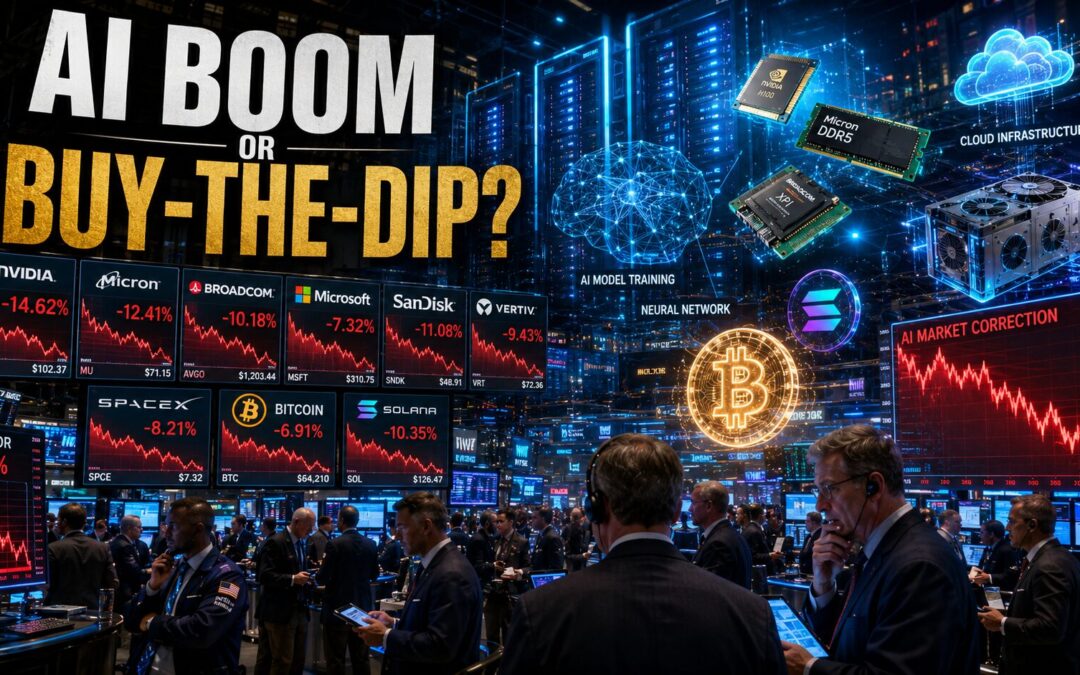
Is the AI Trade Over — or Is This the Dip Investors Were Waiting For?
The AI trade is not over — it is becoming more selective. Nvidia, Microsoft, Broadcom, Micron, SanDisk, Vertiv, and other AI infrastructure names remain long-term winners, but investors should avoid chasing hype and buy in stages during pullbacks. In crypto, Bitcoin may be forming a bottom, while Solana under $70 could be attractive for aggressive long-term investors who understand the volatility.
Key Takeaways
- The AI boom is likely still alive, but the easy money phase is over.
- Nvidia remains the core AI leader, but pullbacks are better entry points than chasing.
- Microsoft may be one of the safest AI compounders.
- Broadcom, Micron, SanDisk, and Vertiv are key AI infrastructure plays.
- The next phase of AI is about chips, memory, storage, power, cooling, and data centers.
- Buy the dip selectively, not blindly.
- Bitcoin may be bottoming, but confirmation is still needed.
- Solana under $70 may be attractive, but only with strong risk management.
- AI and crypto convergence could become a major future theme.
Today’s market action felt like a gut punch for anyone invested in the AI boom.
Micron got hit hard. SanDisk sold off sharply. Vertiv pulled back. Broadcom and Nvidia weakened. SpaceX showed post-IPO volatility. Bitcoin slipped. Solana fell under $70. The market suddenly went from “AI euphoria” to “wait, is this a bubble?” almost overnight.
But that is exactly how real bull markets work.
They do not move in straight lines. They shake people out. They punish late buyers. They scare momentum traders. They create headlines that make long-term investors question their thesis at precisely the moment when discipline matters most.
The real question is not whether AI stocks can go down. Of course they can. Many of them had run too far, too fast.
The real question is this:
Has the long-term AI investment thesis changed?
My answer: no.
But the strategy needs to change.
The easy money phase of AI may be over. The “buy anything with AI in the headline” phase is probably over. But the deeper, more durable AI infrastructure cycle may still have years to run.
This is no longer just about Nvidia.
The next phase is about the full AI stack: chips, memory, networking, power, cooling, cloud infrastructure, storage, software, data, energy, robotics, automation, and eventually quantum computing.
That means investors should stop thinking about AI as one trade and start thinking about it as a decade-long infrastructure buildout with multiple waves.
How Long Can the AI Trade Last?
The AI trade is not a one-year story.
It is more likely a multi-stage technology cycle that runs through the end of this decade, but with violent corrections along the way.
Here is how I see the AI timeline:
Phase 1: The Nvidia Awakening
This was the first wave.
Investors realized Nvidia was not just a gaming-chip company. It was the arms dealer of the AI revolution. Every cloud company, every AI lab, every sovereign AI project, and every enterprise AI platform needed GPUs.
That phase created massive gains in Nvidia and anything directly tied to AI compute.
Phase 2: The Data Center Arms Race
This is where we are now.
AI is no longer just a software story. It is a physical infrastructure story.
The world needs more data centers. More power. More cooling. More memory. More storage. More networking. More chips. More custom silicon. More electrical infrastructure.
This phase benefits companies like Nvidia, Broadcom, Micron, SanDisk, Vertiv, Dell, AMD, Marvell, Arista, Super Micro, and others.
This phase can still run for years because data centers are not built overnight. Hyperscalers are making multi-year commitments. AI infrastructure spending is not a short-term experiment anymore. It is becoming strategic national and corporate infrastructure.
Phase 3: The Monetization Test
This is the phase that will separate the real winners from the hype.
At some point, investors will ask: who is actually making money from AI?
It will not be enough to say, “We are investing in AI.” Companies will need to show revenue growth, margin expansion, productivity gains, customer adoption, and real return on capital.
Microsoft has an advantage here because it can plug AI directly into Office, Azure, GitHub, Windows, security, enterprise workflows, and cloud services.
Nvidia also has an advantage because it sells the essential hardware layer.
But weaker AI companies that cannot show real monetization may collapse.
Phase 4: AI Everywhere
The next stage will be inference, agents, robotics, edge computing, healthcare, industrial automation, defense, and personal AI assistants.
This is where AI moves from the data center into the real economy.
The biggest winners may not only be chip companies. They may be companies that use AI to reduce labor costs, automate workflows, improve logistics, discover drugs, manage energy, build robots, or transform customer service.
This phase could last well into 2030 and beyond.
My Big Picture View
The AI trade is not over.
But the market is now forcing investors to become more selective.
In 2023 and 2024, investors could buy almost anything related to AI and make money.
In 2026, that is no longer the case.
From here, the winners will likely fall into three categories:
First, the core AI platforms. These are companies like Nvidia, Microsoft, Broadcom, and possibly AMD. They are foundational to the AI economy.
Second, the infrastructure enablers. These include Micron, SanDisk, Vertiv, Dell, Arista, Marvell, and companies tied to memory, storage, networking, power, and cooling.
Third, the application winners. These will be the companies that actually use AI to generate measurable profits in software, healthcare, finance, defense, robotics, cybersecurity, and automation.
The mistake is assuming every AI pullback is a buy.
The opportunity is knowing which dips are temporary and which ones are warnings.
Nvidia: Still the King, But Not Risk-Free
Nvidia remains the center of the AI universe.
If the AI boom continues, Nvidia should remain one of the most important companies in the world. It has the hardware, software ecosystem, developer mindshare, customer relationships, and pricing power that competitors still struggle to match.
But investors need to understand something important:
Nvidia is no longer undiscovered.
At this size, the stock does not need good news. It needs great news. Expectations are enormous. Any slowdown in hyperscaler spending, margin pressure, supply disruption, or competitive threat could cause sharp corrections.
My view: Nvidia is still a long-term core AI holding, but I would not chase it after vertical moves. I would buy it in stages on weakness.
A reasonable approach would be:
Buy a starter position on a 10% correction.
Add more if it pulls back 15% to 20%.
Add again only if earnings confirm the thesis.
Do not go all-in on one day.
Nvidia is still a buy-the-dip candidate, but only with discipline.
Micron: Huge AI Tailwinds, But Now a Volatility Machine
Micron is one of the most important AI infrastructure names because memory is becoming one of the biggest bottlenecks in the AI economy.
AI systems need massive amounts of high-bandwidth memory. Every larger model, every inference cluster, and every data center expansion increases memory demand.
That is the bullish case.
The risk is that Micron is still a cyclical semiconductor stock. Memory markets can be brutal. When pricing is strong, earnings explode. When pricing rolls over, investors panic.
After a massive run, Micron is no longer a simple “cheap AI stock.” It is a high-momentum, high-expectation name.
My recommendation: Micron is buyable only in tranches. Do not chase. Do not assume every dip is safe. Wait for either a deeper correction or earnings confirmation.
If you already own it, I would consider holding a core position but trimming oversized exposure after huge moves.
If you do not own it, I would look to build slowly.
Micron is a great AI stock, but not a low-risk stock.
SanDisk: Massive Winner, Massive Risk
SanDisk is a pure play on AI storage demand.
The bullish thesis is obvious: AI creates data, data needs storage, and storage demand is exploding.
But after a monster move, the stock is vulnerable to violent pullbacks. When a stock rises too quickly, even good news can cause selling if expectations become unrealistic.
My recommendation: SanDisk is not a stock to blindly buy after a huge run. It is a stock to watch for a proper base.
I would not chase it.
I would wait for one of three things:
A multi-week consolidation.
A retest of major support.
Or a strong earnings report followed by a calm market reaction.
If it stabilizes after the selloff, SanDisk could remain one of the strongest AI storage plays. But right now, position sizing matters more than excitement.
Broadcom: One of the Best AI Infrastructure Buys on Weakness
Broadcom may be one of the most important underappreciated AI winners.
Nvidia gets the attention, but Broadcom sits in the custom silicon and networking layer. As hyperscalers build their own AI chips and need massive networking infrastructure, Broadcom becomes increasingly important.
This is not a meme stock.
This is a real cash-flow machine with a serious AI growth engine.
My recommendation: Broadcom is one of the AI names I would be most comfortable accumulating on meaningful pullbacks.
It has exposure to custom AI accelerators, networking, enterprise software, and infrastructure. It is not as pure as Nvidia, but that diversification may actually be a strength.
If an investor wants AI exposure but does not want to bet everything on GPUs, Broadcom belongs near the top of the list.
Microsoft: The Safest AI Compounder
Microsoft is not the most explosive AI stock.
But it may be one of the safest.
The company has multiple ways to win:
Azure cloud growth.
Copilot subscriptions.
Enterprise AI adoption.
GitHub developer tools.
Security products.
OpenAI exposure.
Productivity software integration.
Microsoft does not need AI to become a separate business. It can embed AI into products that hundreds of millions of people already use.
That is incredibly powerful.
My recommendation: Microsoft is a buy on weakness for long-term investors.
It may not double as fast as smaller AI stocks, but it also carries less single-product risk. In a volatile AI market, Microsoft is the kind of stock investors can own without needing to watch every tick.
If Nvidia is the engine of AI, Microsoft may be the operating system of AI.
Vertiv: The Pick-and-Shovel Winner Nobody Should Ignore
Vertiv is one of the best examples of why the AI trade is bigger than chips.
AI data centers require enormous power and cooling infrastructure. The more GPUs the world deploys, the more important electrical systems, liquid cooling, thermal management, and power reliability become.
That is Vertiv’s world.
The stock has already had a major run, so investors need to be careful. But the long-term thesis is excellent.
My recommendation: Vertiv is a buy on deeper pullbacks, not a chase.
If the stock drops sharply because of broad AI selling rather than company-specific weakness, I would view that as an opportunity.
The AI boom cannot continue without power and cooling.
That makes Vertiv one of the most important infrastructure names in the market.
SpaceX: Incredible Company, Dangerous Valuation
SpaceX is one of the most important companies in the world.
But great companies can still be risky stocks if the valuation is too high.
SpaceX has exposure to launch services, Starlink, defense, satellites, communications, and possibly space-based infrastructure. Long term, it may become one of the defining companies of the 21st century.
But after an IPO or major public listing, volatility is normal. Early hype often gives way to price discovery.
My recommendation: SpaceX is a long-term accumulation candidate only for investors who can handle extreme volatility.
Do not buy it because of hype.
Buy it only if you believe in the 10-year story and are willing to sit through 30% to 50% drawdowns.
I would rather buy SpaceX after a base forms than chase early excitement.
Is This a Buy-the-Dip Moment?
Yes — but only selectively.
This is not a moment to buy everything.
This is a moment to separate the AI leaders from the AI tourists.
My preferred buy-the-dip list would look like this:
Highest Conviction Long-Term AI Buys
Nvidia
Microsoft
Broadcom
Vertiv
Higher-Risk, Higher-Upside AI Infrastructure Buys
Micron
SanDisk
AMD
Marvell
Arista
Dell
Speculative or Timing-Sensitive Names
SpaceX
CoreWeave
Nebius
Smaller AI infrastructure stocks
The best strategy is not to guess the exact bottom.
The best strategy is to scale in.
Buy 25% of your intended position now.
Buy another 25% if the stock drops further.
Buy another 25% after earnings confirms the thesis.
Keep 25% in reserve for a panic flush.
This gives you exposure without letting emotion control the trade.
What About Crypto?
Crypto looks ugly, but that does not automatically mean the cycle is over.
Bitcoin is under pressure. Solana is weak. Risk assets are selling off. Sentiment is fragile.
But that is often when long-term opportunities begin to form.
The issue is timing.
Crypto bottoms rarely feel comfortable. They usually happen when people are tired, frustrated, and convinced the thesis is broken.
Is Bitcoin Bottoming?
Bitcoin may be attempting to bottom, but confirmation matters.
I would not say the bottom is officially in yet.
For Bitcoin to look healthier, I would want to see:
A strong hold above recent lows.
A reclaim of key moving averages.
Improving ETF flows.
Lower leverage.
Better reaction to bad news.
Bitcoin near the low-$60,000s is interesting for long-term investors, but I would still use a staged approach.
My Bitcoin strategy would be:
Buy some under $65,000.
Add more if Bitcoin reclaims $70,000 with strength.
Keep cash ready in case it flushes toward the mid-to-high $50,000s.
If Bitcoin loses major support with volume, patience is better than panic buying.
Long term, Bitcoin remains one of the best asymmetric macro assets in the world. Short term, it still needs to prove the bottom.
Is Solana a Buy Under $70?
This is the most interesting crypto question right now.
My answer: yes, Solana under $70 is attractive for aggressive long-term investors — but only with proper risk management.
Solana remains one of the strongest ecosystems in crypto. It has retail activity, meme coin activity, developer energy, fast transactions, consumer apps, DeFi, NFTs, payments, and growing institutional interest.
But Solana is also volatile. It can drop much further than people expect.
That means the right move is not to go all-in under $70.
The right move is to scale.
My Solana strategy would be:
Buy a starter position under $70.
Add more in the $58 to $62 range if the market flushes.
Add more only if Solana reclaims $75 to $80 with strength.
Keep some cash available in case crypto has one more major liquidation event.
Solana is a buy under $70 for believers in the ecosystem, but it is not a risk-free buy.
If Bitcoin breaks down badly, Solana could easily go lower.
The Real Opportunity: AI Plus Crypto
One of the biggest themes over the next few years may be the convergence of AI and crypto.
AI needs payments.
AI agents need wallets.
AI marketplaces need settlement rails.
Digital identity, data ownership, tokenized communities, compute networks, DePIN, and autonomous software agents may all become part of the next crypto cycle.
This is why I would not write off crypto just because Bitcoin and Solana are weak today.
The next bull phase may not be about random speculation alone.
It may be about AI-powered on-chain economies.
Final Takeaway
The AI trade is not dead.
It is maturing.
That means investors need to stop buying hype and start buying structure.
The next phase of the AI boom will reward companies with real demand, real infrastructure, real revenue, and real strategic importance.
Nvidia still matters.
Microsoft still matters.
Broadcom still matters.
Micron, SanDisk, and Vertiv still matter.
Bitcoin and Solana still matter for the next phase of digital assets.
But the strategy must evolve.
Do not chase vertical moves.
Do not panic sell quality.
Do not go all-in on one dip.
Do not confuse volatility with a broken thesis.
The AI boom may last into 2030, but it will not reward everyone equally. It will reward investors who understand the layers, buy weakness intelligently, manage risk, and stay focused on the long-term transformation.
The market is shaking out weak hands.
That does not mean the opportunity is over.
It may mean the next great entry point is being built right in front of us.
Research Notes / Sources Used
Nvidia remains a core AI bellwether, with its data-center chip roadmap and revenue outlook still central to the AI infrastructure story. Broadcom’s official Q1 2026 release reported AI revenue growth driven by custom AI accelerators and AI networking, supporting the thesis that Broadcom is a major AI infrastructure play. Big Tech’s AI capex remains enormous, with estimates around hundreds of billions of dollars for data centers, chips, and infrastructure. Current selloff pressure is concentrated in semiconductors, memory, and AI infrastructure stocks, with Micron, SanDisk, Nvidia, and Vertiv among the names seeing significant volatility. Current crypto pricing shows Bitcoin in the low-$60Ks and Solana under $70, making the “is this a bottom?” question timely.
Disclaimer: This is for educational and informational purposes only, not financial advice. Investing involves risk, including loss of principal. Use your own research, risk tolerance, and professional guidance before making investment decisions.