
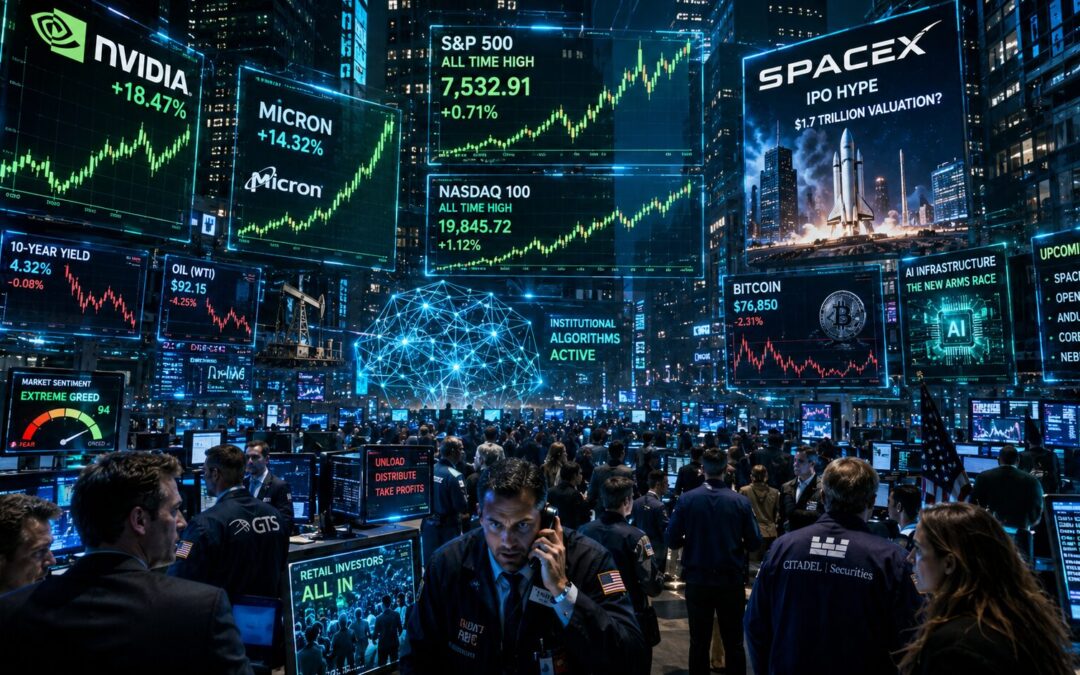
Markets at All-Time Highs While Bitcoin Struggles: Gareth Soloway Warns of Institutional Hype, Semiconductor Mania, and IPO Exit Liquidity
The financial markets continue to push toward record highs, but beneath the surface, veteran trader Gareth Soloway believes a far more complex story is unfolding.
In a recent market breakdown, Soloway explained how falling oil prices, declining Treasury yields, AI-driven semiconductor enthusiasm, and massive upcoming IPOs may be creating an environment fueled more by institutional positioning and algorithmic trading than by genuine economic strength.
According to Soloway, investors remain “insatiably” bullish despite ongoing macro uncertainty, geopolitical tensions, and stretched valuations. He argues that institutional players may be intentionally maintaining market optimism ahead of enormous IPO events like the anticipated SpaceX offering and future AI-related public listings.
Oil Prices and Treasury Yields Are Driving the Market
One of the key themes Soloway highlighted is the relationship between oil prices, Treasury yields, and equity market performance.
He explained that when crude oil prices decline and the 10-year Treasury yield falls, institutional trading algorithms automatically buy equities, especially the S&P 500 and technology stocks.
Oil recently dropped sharply after renewed optimism surrounding the possible reopening of the Strait of Hormuz, pushing WTI crude near the $92-per-barrel level. At the same time, Treasury yields pulled back toward the important 4.5% level.
Soloway believes this dynamic is critical because modern markets are heavily controlled by algorithmic systems programmed to react automatically to macro indicators.
“When oil ticks down, S&P futures get bought. When the 10-year yield ticks down, the S&P gets bought.”
This relationship has helped propel markets higher even as many investors remain concerned about inflation, economic slowing, and geopolitical instability.
The Semiconductor Trade Has Become the New Safe Haven
One of the most fascinating parts of Soloway’s analysis involves semiconductors and AI infrastructure stocks.
Traditionally, investors view defensive sectors like utilities, healthcare, or dividend-paying stocks as “safe havens” during uncertain periods. However, Soloway argues that in the current AI-driven environment, semiconductor companies have effectively become the new safe haven trade.
His reasoning is simple:
Even if oil prices rise and inflation remains elevated, major technology companies like Google, Meta, Microsoft, and Amazon are unlikely to reduce AI spending.
The AI arms race continues regardless of macroeconomic conditions.
That means semiconductor manufacturers powering the AI boom continue attracting massive institutional capital.
This has created extraordinary rallies across global semiconductor markets:
- The NASDAQ continues reaching new highs.
- Taiwan’s stock market recently surpassed India’s market capitalization due largely to semiconductor dominance.
- Japan’s Nikkei surged more than 100% from 2025 lows.
- South Korea’s KOSPI rallied more than 60% in only a few months.
The result is a worldwide semiconductor mania fueled by AI optimism and relentless institutional buying.
Micron’s Massive Upgrade Raises Red Flags
One of Soloway’s biggest warnings focused on Micron Technology.
The stock surged after a major analyst upgrade from UBS raised its price target dramatically.
Micron had already risen roughly 250% during the year, yet analysts suddenly argued the stock deserved even higher valuations.
To Soloway, this behavior resembles classic late-stage bubble psychology.
He suggested institutions may be using aggressive analyst upgrades to create “exit liquidity” — encouraging retail investors to continue buying so large funds can unload massive positions without crashing the stock price.
This type of institutional behavior has appeared repeatedly throughout financial history during speculative manias.
Soloway compared the environment to scenes from the classic movie Wall Street, where hype and public enthusiasm are intentionally manufactured to fuel market speculation.
Why Upcoming IPOs Could Be Influencing Market Behavior
Another major concern Soloway discussed involves massive upcoming IPOs.
He specifically pointed to the expected SpaceX IPO, rumored to involve valuations near $1.7 trillion, along with future AI company offerings.
According to Soloway, institutions have a strong incentive to keep markets elevated and investor sentiment extremely bullish ahead of these offerings.
Why?
Because successful IPOs require strong retail demand.
If markets were collapsing or investor confidence deteriorated, institutions could struggle to distribute shares profitably.
As Soloway explained:
“They need to keep investor sentiment strong so retail investors will clamor to buy that IPO.”
He also referenced previous IPO examples like Cerebras Systems and Figma, noting how some high-profile IPOs initially surged before quickly retracing.
Bitcoin Still Showing Relative Weakness
While equities continue making new highs, Bitcoin has struggled to keep pace.
Soloway pointed out that Bitcoin recently traded below $77,000 while stock markets remained near all-time highs.
This divergence is important because many crypto investors expected Bitcoin to strongly outperform during periods of aggressive money printing, geopolitical instability, and institutional adoption.
Instead, Bitcoin’s weaker relative performance may suggest:
- Liquidity is still flowing primarily into AI and semiconductor stocks
- Institutions remain focused on traditional equities
- Crypto markets could still face volatility despite long-term bullish narratives
Gold and silver also failed to rally significantly, which Soloway described as another unusual market dynamic.
The Bigger Picture: Are Markets Being Artificially Supported?
At the core of Soloway’s thesis is the idea that modern markets are increasingly influenced by:
- Institutional algorithms
- Liquidity engineering
- Sentiment management
- AI hype cycles
- Retail speculation
- IPO positioning
He believes these forces may be temporarily overriding traditional fundamentals.
That does not necessarily mean an immediate crash is coming.
In fact, Soloway repeatedly emphasized that markets could continue climbing higher in the near term.
However, he warned investors not to confuse momentum with safety.
Eventually, the “rug pull” risk increases when valuations become disconnected from reality and institutions begin distributing shares to euphoric retail buyers.
Final Thoughts
The current market environment represents one of the most unusual investing periods in modern history.
Artificial intelligence, semiconductors, algorithmic trading, and institutional liquidity are reshaping traditional market behavior in real time.
Semiconductor stocks are acting like defensive assets.
Oil and Treasury yields are controlling algorithmic equity flows.
Retail investors continue chasing AI narratives.
And massive IPOs may be incentivizing institutions to maintain bullish sentiment for as long as possible.
Whether this environment continues or eventually reverses sharply remains unknown.
But Soloway’s message is clear:
Understand the psychology behind the market — not just the headlines.

NORMIE: The Future of Human Behavior Is Going Viral
What if the internet could map human psychology in real time?
Normie combines viral “Would You Rather?” polls, AI, memes, personality systems, and SocialFi to create a live behavioral intelligence network powered by the crowd.
Every vote reveals something deeper:
🧠 How people think
❤️ How they feel
💰 How they make decisions
🤖 How humanity evolves in the AI era
This isn’t just content.
It’s the beginning of the behavioral economy.
🚨 Join the movement before the masses arrive.
Would You Rather Find True Love OR Become Financially Free Forever?
Vote. Debate. Discover yourself.
Help build the world’s largest map of human behavior.
🌐 https://normie.one/
🐦 https://x.com/normie765714
💬 https://t.me/normieone
📺 https://www.youtube.com/@PersonalityPolls
#Normie #SocialFi #AI #Psychology #WouldYouRather #BehavioralIntelligence #Crypto #Memecoins